


Blast-Resistant Door: Understanding EN 13123 / EN 13124 Standards and EXR Classes
A blast-resistant door is a door engineered to withstand the shock wave and overpressure generated by a deflagration, in order to protect people, equipment, and the operational continuity of an exposed building. Its resistance is assessed at European level through standards EN 13123 (requirements and classification) and EN 13124 (test methods), with resistance classes ranging from EXR1 to EXR5. This is a critical performance requirement for sensitive sites: energy infrastructure, chemical and petrochemical industries, data centres, embassies, command posts, military installations, and defence buildings.
Why Protect a Building Against Explosion?
Within a physical security and counter-terrorism approach, a door does not merely close or control access: it can absorb part of the blast effect, compartmentalise a risk zone, and preserve a strategic access point. Blast-resistant doors address three families of threats: anti-blast (pressure wave), explosion proper, and breaching (charge applied in contact or in close proximity to the door leaf).

The Normative Framework: European Standards and International References
European Standards EN 13123 / EN 13124
Two series of standards coexist depending on the explosion scenario under consideration.
EN 13123-1 / EN 13124-1 — Shock tube test. This method simulates distant explosions with large charges: from 100 to 2,500 kg of TNT at distances of 35 to 50 m. It yields a classification of EPR1 to EPR4.
EN 13123-2 / EN 13124-2 — Free-field test (arena test). This is the reference method used by Heinen: the door is subjected to a real explosion under controlled conditions, with charges of 3 to 20 kg of TNT at 3 to 5 m. It yields a classification of EXR1 to EXR5.
In summary: EN 13124 defines the test methods; EN 13123 defines the requirements and assigns the resulting resistance class.
International Sector Standards
PIP STC01018 — American petrochemical standard. It is based on calculations derived from coefficients obtained through real-world tests and defines three damage levels: LOW, MEDIUM, and HIGH.
UFC 3-340-02 — Global military standard. Design guide from the US Department of Defense, based on dynamic calculations and decades of actual explosive testing.
EPR and EXR: Two Classification Logics
The distinction between EPR and EXR is fundamental to correctly interpreting a specification, and it is frequently misunderstood.
EPR corresponds to larger charges at greater distances. The peak pressure is relatively low, but the impulse is high. This is the typical scenario of an accidental industrial explosion or a long-range attack.
EXR corresponds to smaller charges at close range. The peak pressure is high, but the impulse is short. This is the scenario of a breaching attempt or a charge placed in immediate proximity to the door leaf.
An important physical point: peak pressure decreases faster than impulse with distance. At long range (EPR), impulse therefore dominates; at short range (EXR), instantaneous pressure is the prevailing factor.
Minimum values for EPR classes (EN 13123-1):
| PRESSURE | IMPULSE | |||||
|---|---|---|---|---|---|---|
| Class | Pmax (bar) | Pmax (psi) | Pmax (kPa) | i+ (bar·ms) | i+ (psi·ms) | i+ (kPa·ms) |
| EPR1 | 0,50 | 7,25 | 50 | 3,7 | 53,67 | 370 |
| EPR2 | 1,00 | 14,50 | 100 | 9,0 | 130,53 | 900 |
| EPR3 | 1,50 | 21,76 | 150 | 15,0 | 217,56 | 1 500 |
| EPR4 | 2,00 | 29,01 | 200 | 22,0 | 319,08 | 2 200 |
Note: the duration of the positive phase (t+) must not be less than 20 ms.
Values for EXR classes (EN 13123-2):
| PRESSURE | IMPULSE | ||||||
|---|---|---|---|---|---|---|---|
| Class | Charge TNT à distance | Pso (bar) | Pso (psi) | Pso (kPa) | iso (bar·ms) | iso (psi·ms) | iso (kPa·ms) |
| EXR1 | 3 kg at 5 m | 0,75 | 10,88 | 75 | 1,05 | 15,23 | 105 |
| EXR2 | 3 kg at 3 m | 2,30 | 33,36 | 230 | 1,65 | 23,93 | 165 |
| EXR3 | 12 kg at 5,5 m | 1,70 | 24,66 | 170 | 2,25 | 32,63 | 225 |
| EXR4 | 12 kg at 4 m | 3,60 | 52,22 | 360 | 3,00 | 43,51 | 300 |
| EXR5 | 20 kg at 4 m | 6,30 | 91,37 | 630 | 4,20 | 60,92 | 420 |
Conversion note: 1 bar = 14.504 psi = 100 kPa = 100 kN/m² ≈ 10 t/m²
Pressure and Impulse: Two Inseparable Concepts
Pressure represents the maximum intensity of the force exerted by the shock wave at any given instant.
Impulse accounts for the duration over which that pressure is applied.
A very violent but very brief shock (high pressure, low impulse) does not produce the same effects as a less intense but sustained push. Pressure primarily causes sudden deformation; impulse places greater demands on the anchoring system. A rigorous specification therefore integrates both parameters.
The Dynamic Nature of an Explosion
An explosion always has a dynamic character, fundamentally different from a static load. A shock wave reaches its peak pressure within a few milliseconds, decays very rapidly, and then reverses: the door is successively pushed by a positive pressure phase, then pulled by a negative pressure phase.

A Performance to Be Designed as a Complete System
This is the essential point: blast resistance is never limited to the door leaf alone. It depends on the complete assembly, leaf, frame, hinges, lock, closing points, anchors and installation support, which must function as a coherent whole. Added to this are the risk level, the building configuration, the opening direction, the dimensions and the quality of installation.
Thanks to the Metal+ Inside concept, blast resistance can also be combined with other performances: fire resistance, intrusion resistance, bullet resistance, acoustic insulation or access control, all within the same tubular steel structure.

Heinen Open-Air Range Tests
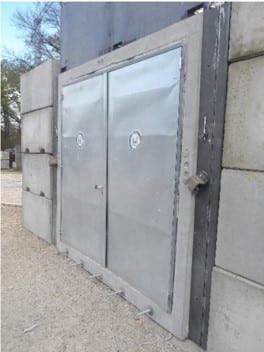
Heinen carried out a series of tests together with the company BS&A at an open-air firing range, under free-field test conditions (arena test).
| Direction of the blast | Single door | Double door |
|---|---|---|
| Hinge sideGenerally the most favourable configuration | EXR3 | EXR3 |
| Non-hinge sideUnfavourable exposure direction | EXR1 | EXR1 |
Key point for specification — for an identical configuration, performance drops from EXR3 to EXR1 depending on the exposure direction. The likely direction of the shock wave must therefore be treated as a design parameter in its own right, to be factored in from the specification stage on the same footing as the targeted threat level.
Classes tested: EXR1, EXR2, EXR3 · Single and double doors · Each configuration tested in both exposure directions.
Note: Heinen Doors has not yet obtained certification. This is currently in progress.
Application Environments
- High-risk industry: chemical and petrochemical sites (PIP STC01018)
- Energy: nuclear and thermal power plants, critical infrastructure
- High security: embassies, command posts, military sites (UFC 3-340-02)
- Infrastructure: data centres, underground transport structures
FAQ — Blast-Resistant Doors
A blast-resistant door is a door engineered to withstand the overpressure and shock wave of a deflagration, assessed in accordance with European standards EN 13123 / EN 13124 and classified from EXR1 to EXR5.
EN 13124 describes the test methods; EN 13123 describes the requirements and the classification of the performance achieved.
They are the levels of blast resistance, from least to most severe, assigned after testing in accordance with EN 13123-2. Each class corresponds to a combination of explosive charge (kg TNT) and test distance.
Pressure reflects the instantaneous intensity of the blast; impulse reflects its cumulative effect over time. Both parameters govern the behaviour of the door under explosive loading.
Yes. During Heinen’s tests (March–April 2026), the EXR3 level was achieved on the side opposite to the opening direction, compared to EXR1–EXR2 on the opening side.
Yes. Thanks to the Metal+ Inside concept, blast resistance can be combined with fire resistance, intrusion resistance, bullet resistance, or acoustic insulation.
No. Performance depends on the complete system: frame, hinges, lock, closing points, anchors, and the supporting structure.