


Ventilated Doors: How to Keep Air Moving Without Compromising Security
A ventilated door, also referred to as a louvred door in common usage — is a door fitted with a louvred grille that allows air to circulate freely between two spaces, whilst maintaining its core functions: physical closure and, where required, fire resistance or security performance.
These doors are essential wherever a room needs to breathe: plant rooms, boiler rooms, LV switchgear rooms (MCC/LVDB), bin stores, car parks, server rooms and battery rooms.
The challenge seems contradictory at first glance. Cutting an opening into a door appears to weaken it by definition. That is precisely where the difference lies between a grille bolted on as an afterthought and a certified, tested louvred grille that is engineered into the door from the outset.
Why Do Some Rooms Require a Ventilated Door?
Certain spaces generate heat, humidity or gases that must be managed continuously — both for occupant safety and to protect the equipment inside. A solid, airtight door is simply not an option.
Common applications include:
- Plant rooms and boiler rooms: heat dissipation and combustion air supply.
- LV switchgear and transformer rooms (MCC/LVDB): equipment cooling.
- Bin stores and storage areas: odour control and prevention of gas build-up.
- Server rooms and battery rooms: temperature management and hydrogen extraction.
- Car parks: ventilation along traffic routes.
In each case, the door must ventilate, but it must also perform as a security or fire door.

The Real Challenge: Combining Ventilation With Performance
A louvred grille introduces an opening, which can conflict with other requirements:
- Security: a poorly designed grille becomes a weak point — a potential attack vector.
- Fire compartmentation: a permanent opening undermines a fire barrier unless the grille closes under heat (the intumescent principle).
The answer is not to “add a grille” to a standard door. It is to design the door around the required performance from the start. This is the core principle behind Heinen’s Metal+ Inside concept: a common tubular steel structure on which fire resistance, security rating and ventilation are combined as required — performance à la carte.
Heinen’s Two Louvred Grille Solutions
Heinen has developed two distinct louvred grille solutions, each addressing a specific set of requirements.
1. The Surface-Mounted Grille — Aesthetics and Fire Rating
- Manufactured from natural anodised aluminium profiles with a stainless steel 304 insect mesh insert, this grille offers a clean finish and can be positioned at the top of the leaf, the bottom, or both.
- Available in two versions: non-fire-rated and fire-rated.
- Fire classification to EN 1634-1 (ISO 834 time-temperature curve), validated by test report from the University of Liège Laboratory: EI₁ 30 / EI₂ 30 and EI₁ 60 / EI₂ 60.
- The fire-rated version uses intumescent elements integrated within the door leaf. The product is also resistant to atmospheric conditions (UV, heat, cold, humidity), making it equally suited to internal and external applications.
- Standard sizes: 4 formats ranging from 380 × 580 mm (leaf width ≥ 580 mm) to 880 × 680 mm (leaf width ≥ 1,080 mm).
- Free air area: up to 24 dm² (non-fire-rated) and 16.56 dm² (fire-rated), depending on format.

2. The Punched Louvred Grille — Fire Resistance and Security Combined
Developed in-house by Heinen, this grille consists of louvres embossed directly into the door’s cover plates. The finish is identical to that of the leaf (Magnelis® ZM 250 galvanised steel or stainless steel 304/316), for seamless visual integration.
- Security performance (to EN 1627–1630):
CR2 and CR3 — no dimensional restriction (excluding free egress); CR4 — up to a module height of 235 mm. - LPS 1175 D10 compliance (a loss-prevention standard widely recognised by UK insurers): up to a grille size of 320 × 200 mm.
- Fire rating: EI₁ 30 / EI₂ 30 and EI₁ 60 / EI₂ 60 (intumescent version).
- Combined fire + security on a single grille: possible up to 510 × 310 mm.
- Standard format: height 235 mm (15 louvres), width equal to leaf width minus 210 mm. Bespoke sizing is available for non-fire-rated doors.
- Positioning: bottom, top, top and bottom, or full-leaf coverage.
- Free air area: dependent on leaf width; the fire-rated version reduces airflow by approximately 31%. Example: a 900 mm leaf provides approximately 3.34 dm² free area (or ≈ 2.30 dm² in the fire-rated version).
Important: both grilles are integrated during door manufacture.
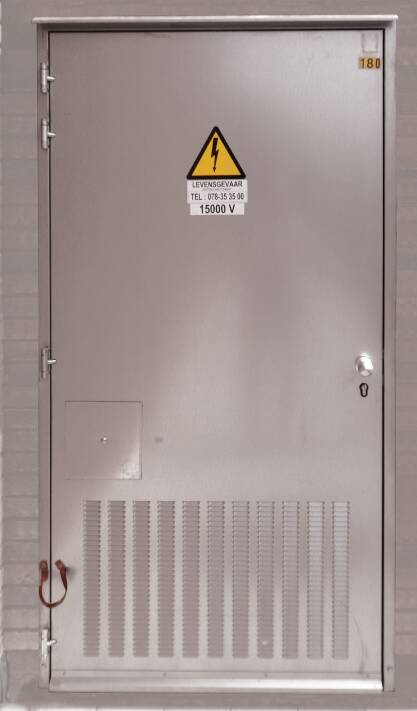
Which Heinen Doors Can Be Supplied With Ventilation?
Louvred grilles are available as an option across most Metal+ configurations:
- Single leaf swing door
- Double leaf swing door
- Rebated single leaf door
- XXL swing door
- Double door without door priority
All available in Magnelis® ZM 250 galvanised steel or stainless steel 304/316, to bespoke dimensions.
Typical Sectors and Applications
Because they address a universal challenge — keeping a room ventilated without sacrificing security — Heinen ventilated doors are specified across virtually every sector:
- Culture, education and sport: museums, schools and leisure centres all house boiler rooms and plant rooms that need ventilating, in buildings where aesthetics matter as much as fire safety.
- Energy and nuclear: critical plant rooms combining ventilation, access control and security rating — transformer rooms, battery rooms and spaces requiring heat or hydrogen extraction.
- Retail and distribution: technical rooms in large commercial premises (refrigeration plant, LV switchgear, bin stores) where airflow must be maintained without compromising fire compartmentation.
- High security: data centres, sensitive sites and custodial facilities, where the punched louvred grille combines ventilation, forced-entry resistance (CR2–CR4, LPS 1175) and fire rating in a single door.
- Industry: process plant protection with heat and atmosphere management — boiler rooms, process areas and electrical switchrooms.
- Car parks: ventilation of traffic routes and plant rooms, for exhaust gas extraction and equipment cooling.
- Residential and commercial: apartment blocks and office buildings whose bin stores, boiler rooms, LV switchgear rooms and shared car parks require controlled, discreet ventilation.
- Social and healthcare: hospitals, care homes and social housing, where plant rooms demand ventilation, hygiene and fire safety in equal measure.
- Transport: plant rooms in rail, airport and road infrastructure — signalling rooms, LV switchgear and tunnels.

Frequently Asked Questions — Ventilated Doors
A ventilated door, sometimes called a louvred door, is fitted with a louvred grille that allows air to circulate between two spaces whilst maintaining physical closure and, depending on the specification, fire resistance or security performance.
Yes. Heinen’s punched ventilation grille is certified to security classes CR2 and CR3 (no dimensional restriction, excluding free egress) and CR4 up to a module height of 235 mm, in accordance with EN 1627–1630. It also meets LPS 1175 D10 up to a grille size of 320 × 200 mm — a standard widely recognised within the UK insurance market.
Yes. Both Heinen grilles are available in fire-rated versions, classified EI₁ 30 / EI₂ 30 and EI₁ 60 / EI₂ 60 to EN 1634-1. They incorporate intumescent elements that seal the opening under heat, preserving fire compartmentation.
Yes, with the punched grille, up to a grille size of 510 × 310 mm.
This depends on the model and dimensions. The surface-mounted grille offers up to 24 dm² (non-fire-rated). The fire-rated version reduces this figure — by approximately 31% for the punched grille.
No. Grilles are integrated during door manufacture. The fire-rated version in particular cannot be retrofitted.
The surface-mounted grille is manufactured from anodised aluminium with a stainless steel 304 insect mesh.
The punched grille matches the leaf finish: Magnelis® ZM 250 galvanised steel or stainless steel 304/316.