


Burglary Resistance standards: understanding EN 1627-1630 (RC classes) and LPS 1175
A door’s burglary-resistance performance is assessed against two major frameworks: the European standard EN 1627-1630 (with its RC resistance classes), well established across the continent, and the British LPS 1175 standard, recognised worldwide by insurers and specifiers of sensitive sites. The first classifies doors according to an attacker profile; the second, since its Issue 8 version, combines a tool category with a resistance time. Understanding both is essential to specify the right door for the real threat level.

The European standard EN 1627-1630: the RC classes
In Europe, the burglary resistance of doors, windows and shutters is governed by a set of standards generally referred to as EN 1627-1630 (sometimes abbreviated EN 1627-30): EN 1627 defines the requirements and classification, while EN 1628, EN 1629 and EN 1630 describe the test methods (static load, dynamic load and manual burglary attempt respectively). This set defines resistance classes designated RC (resistance class; the French notation “CR” is also encountered), from RC1 to RC6.
Each class corresponds to a typical attacker profile, from the opportunistic burglar trying to force the door physically (lower classes) to the experienced offender equipped with powerful power tools (higher classes), with an increasing tool set and resistance time according to the class targeted.
It is a clear and widely specified framework, well known to European architects and engineering firms — hence the choice, in this article, to keep it brief and focus on LPS 1175.
What Heinen offers under EN 1627-1630
Heinen doors, built on the Metal+ Inside concept, offer a broad anti-burglary range from classes RC2 to RC5, in single and double leaf, with or without combined fire resistance. In practice, this burglary + fire combination is available up to EI2 120 for RC4 doors and up to EI2 60 for RC5 doors. Burglary resistance can also be combined with other requirements (acoustic, bullet-resistant) and applied to ventilated doors (up to RC4 on the punched ventilation grille).

LPS 1175: the benchmark British standard
LPS 1175 is a security standard developed by the LPCB (Loss Prevention Certification Board), part of the BRE (Building Research Establishment) in the United Kingdom. While it is not an “official” European standard, it is recognised internationally and in high demand among insurers, the police, security consultants and specifiers of sensitive sites. It applies to the key components of a building: doors, shutters, grilles, fences and walls.
How the classification works (Issue 8)
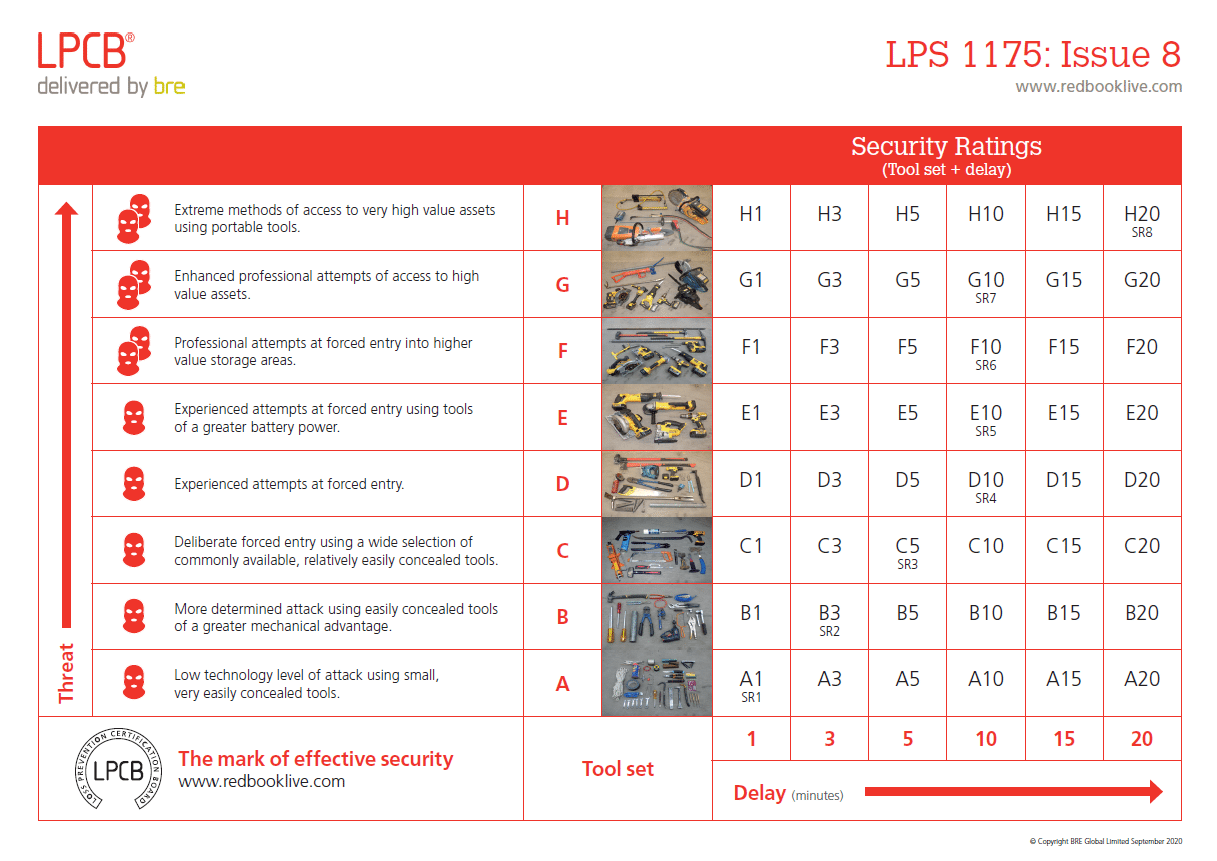
Until 2019, LPS 1175 rated products with a single score, from SR1 to SR8 (Security Rating). The current version, Issue 8 (since 2019), introduced a two-part classification — more refined and more realistic:
- A letter, from A to H: it corresponds to the category of tools used during the test (and, for the highest categories, to the number of attackers). The further along the letter, the more aggressive the tools.
- A number – 1, 3, 5, 10, 15 or 20: it corresponds to the minimum resistance time, in minutes — the time during which the door is not breached.
A rating therefore reads as “letter + number”. For example, D10 means: resists 10 minutes against an attack using category D tools. Important: the delay corresponds to the effective working time (tool actually in contact with the door), excluding the breaks granted to the testers.
This two-part logic makes it possible to separate the tool from the time: you can require long resistance against modest tools, or shorter resistance against very aggressive tools, depending on the site’s real threat — a far more flexible approach than the old SR system.
The LPS 1175 tests carried out by Heinen Doors
Heinen launched an LPS 1175 testing campaign in 2024 and 2025, covering single and double doors. At this stage, the tests were conducted with an attack on the hinge side. The results obtained are as follows:
| Configuration | LPS 1175 classes obtained (Issue 8) |
| Single door | E10, D10, E15 et E20 |
| Double door | E10 et D10 |
In practice, a single Heinen door demonstrated its ability to resist 20 minutes against category E tools (E20) and 10 minutes against categories D and E (D10, E10). The double doors reached D10 and E10. These results place Heinen doors firmly in the demanding field of internationally certified security, complementing the European RC classes.

EN 1627-1630 or LPS 1175: which to choose?
The two are not in opposition; they answer different contexts:
- EN 1627-1630 (RC classes): the standard framework for most European projects, well known to specifiers on the continent.
- LPS 1175: often required for sensitive sites, projects under a British specification, or when the insurer or client explicitly specifies it.
The right choice depends on the client, the country, the insurer’s requirements and the threat level. A door can in fact be designed to meet either framework depending on the project.
FAQ — Burglary Resistant standards
The European standard EN 1627-1630 (resistance classes RC1 to RC6) and the British LPS 1175 standard, recognised internationally.
They are resistance classes (RC1 to RC6), each corresponding to an attacker profile and an increasing set of tools and times. The French notation “CR” (classe de résistance) is also used.
A security standard from the LPCB / BRE (United Kingdom) assessing the intrusion resistance of doors, shutters, grilles and walls. It is widely recognised by insurers and specifiers of sensitive sites.
Since Issue 8, the rating includes a letter (tool category, A to H) and a number (resistance time in minutes: 1, 3, 5, 10, 15 or 20). D10 = 10 minutes against category D tools; E20 = 20 minutes against category E tools.
Issue 7 used a single rating (SR1 to SR8). Issue 8 (since 2019) separates the tool category (A-H) and the resistance time (in minutes), for a finer classification and a layered approach.
In tests carried out in 2024-2025 (attack on the hinge side), Heinen single doors reached D10, E10, E15 and E20, and double doors E10 and D10.
Heinen offers a broad range of doors from classes RC2 to RC5, in single and double leaf, with or without combined fire resistance, up to EI2 120 for RC4 doors and up to EI2 60 for RC5 doors. The exact level is defined project by project.
No. They are two distinct frameworks, with different methods and classifications. The choice depends on the country, the client, the insurer and the threat level.